Showing posts with label Amphibian. Show all posts

Wednesday, March 23, 2016

Lab #8

Date: 3/23/16
Location: Lumber River Conservancy
Lab Activity: Searching for spotted turtles
Habitat: Vernal Pool
Temperature: 81.1 F
Wind: 3.5 mph
Humidity: 33%

    Myself and the rest of the Field Zoology class went out to the Lumber River Conservancy looking for spotted turtles, unfortunately we didn't find any.
Southern Cricket Frog (Acris gryllus)


    The Southern Cricket Frog, is a small frog and member of the family Hylidae which makes it a treefrog. You can find Southern Cricket Frogs in coastal plain bogs, ponds and in our case vernal pools. 

    They have a distinct linear "Y" shaped marking on their back, though often green the marking can vary in shade and color as well as pronouncement.

    Though they are called cricket frogs they mostly feed on smaller insects like mosquitoes, some crickets would actually be the same size as this frog and would prove difficult to swallow.


Wednesday, March 16, 2016

Two Toed Amphiuma (Amphiuma means)


    Sometimes referred to as a Congo Eel or a Leggy Eel, the Amphiuma is actually not an eel at all infact it is an amphibian. It is a member of the family Amphiumidae and can be recognised by its long slender body and by its four small vestigial legs. The Amphiumas is actually the longest amphibians in North America, the two toed amphiuma reaches lengths of around 45 inches.

    You can find Amphiumas in freshwater systems such a creeks, ponds and rivers. They are often the largest and top predator in their territory. You can sometimes find these guys on land. The amphiuma will crawl on land to move out of one body of water in search of another.


Lesser Siren (Siren intermedia)


    The lesser siren is the smaller of the two siren species found in North Carolina, the other being the Greater Siren. You can identify siren by its long slender eel like body, with its little forelimbs and exposed gills.

    The lesser siren is an amphibian and a member of the Sirenidae; you can find them in various freshwater systems but often in ditches and narrow creeks. They are aggressive predators and like to feed on small arthropods and gastropods. 


Wednesday, February 17, 2016

Tiger Salamander Ambystoma Tigrinum

\


    The pattern of the Tiger Salamanders vary and can be spotted like the one we found but are usually striped like the name suggests. The base color is black and they have yellow markings. They have a short snout and can reach lengths of up to 14 inches making them the largest terrestrial salamander alive.

    You can find the Tiger Salamander over most of the continental USA, and you can find them burrowed in holes or underneath coverups like logs or metal sheets.


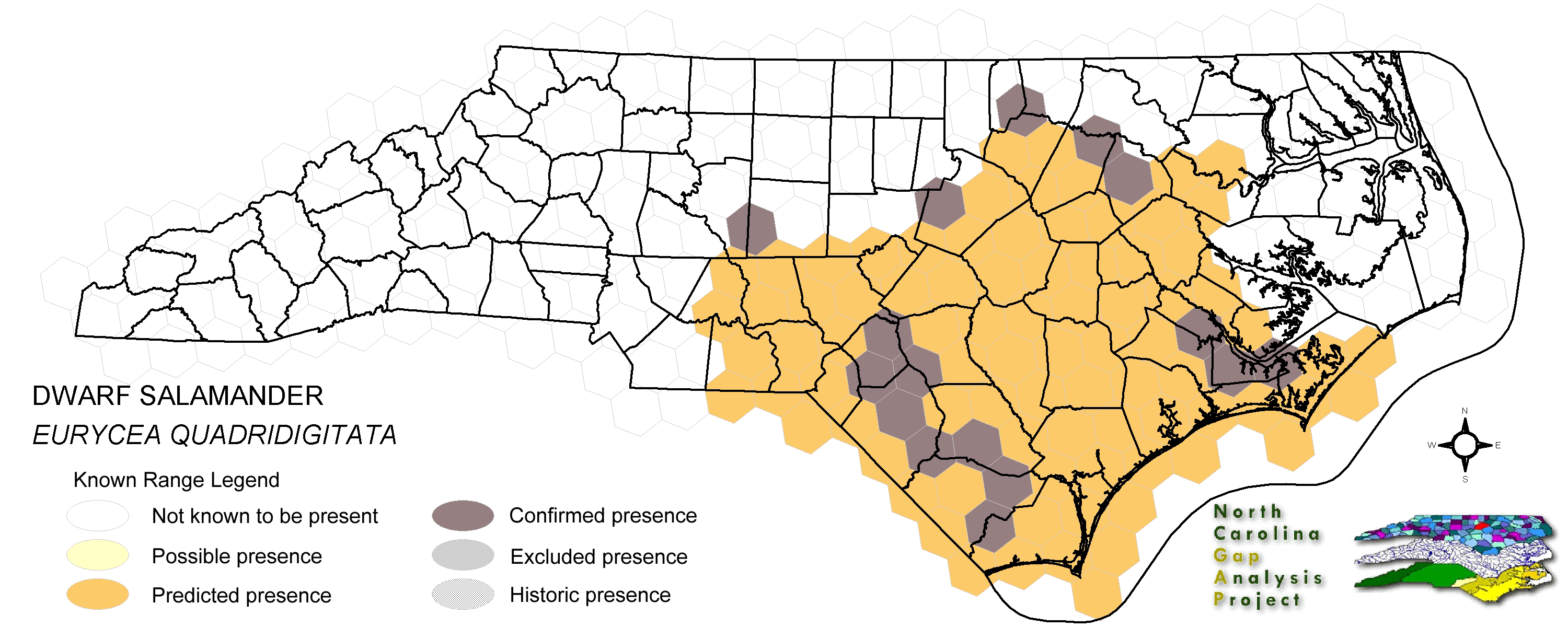
Dwarf Salamander Eurycea quadradigitata


    When we first caught one these guys, we misidentified it as a four toed salamander. As the name implies the Dwarf Salamander is very small in size and don't usually get any bigger than 3.5 inches. Apart from the small size you can identify them by their long slender bodies and tail. 

    The Dwarf Salamander is a rare species in North Carolina, which is why it is classified as species of concern. Their habitat in North Carolina spreads across most of the Coastal Plain, minus the northeastern corner. 


Spring Peeper (Pseudacris crucifer)


    The Spring Peeper, which is distinctively recognized by the X shaped marking on its back, is a member of the family hylidae which makes it a tree frog. These guys will call out in huge choruses and often drown out the sound of any other frogs calling and they start peeping right around the beginning of spring. 


 Spring Peeper Calling in Chorus

Mabee's Salamander (Ambystoma mabeei) 


    The Mabee's Salamander is an example of mole salamander, family Ambystomatidae. The adults are dark in color with small light colored splatters of color all over the topside of the animal. This species is not particularly common in this area so we were lucky to find it. The adults are mostly terrestrial but will usually remain near to a breeding area which usually takes the form of a vernal pool like where we found this or a pond.    

Southern Chorus Frog (Pseadacris nigrita)


We did not actually get to see this species but rather we only heard it in the background.

   The southern chorus frog has a call which can be best compared to a xylophone and can be heard singing during most parts of the day typically near shallow bodies of water. They breed from November to April throughout most of their range but have been known to breed year round in Florida.

   Its underside color varies from whitish gray to a more tan color and its back is marked with dark broken lines or spots. Most southern chorus frogs have a line starting at their eyes and running down their sides.


 Southern Chorus Frog Call


Wednesday, February 3, 2016

Pine Woods Treefrog (Hyla femoralis)


    As the name suggests the Pine Woods Treefrog is a mostly arboreal species, but this one was found underneath a coverup. It may have been looking for a place to moisten up or it could have been looking for a small insect to feast on. 

    These frogs can be brown, green or gray in coloration, but if you have a male you will can identify it by the orange flares on the thigh. 

    Their diet consists mainly of animals such as ants, beetles, crickets, moths and other small arthropods.

   Pinewoods Treefrog call

Atlantic Coast Slimy Salamander (Plethodon chlorobryonis)

    This species was found underneath one of the pre-setup coverboards probably using it for shelter and gather up some moisture. It may have also been looking for some food. The slimy's main diet consists of spiders, harvestmen, and other such small terrestrial arthropods.

    You can identify this species by its solid black colored body which is covered in several tiny white dots. Adults of this species can be anywhere from 4.5 inches or as long as 8 inches from head to tail. 

    The slimy is a member of the Plethodontidae family of salamanders, commonly known as the lungless salamanders. The slimy doesn't breath with gills either as it is a terrestrial species, they instead breath through their skin and membranes lining their mouths and throats.