Showing posts with label Jan 20th. Show all posts

Wednesday, January 20, 2016

Lab #1

Date: 20 January, 2016
Location: Lumber River Conservancy
Lab Activity: Bird Surveying 
Habitat: Pine/Hardwood Forest on and near the Lumber River floodplain
Temperature: 39.3 F - 46.8 F
Wind: 2.1 mph
Humidity: 23.8% - 24%
Additional Information: There was a lot of cloud cover.

    We went out to an area near the Lumber River to look for birds.


Pileated Woodpecker (Hylatomus pileatus)

 Male
Female


The Pileated Woodpecker is the largest woodpecker species that you will see in North Carolina. They are easily identified by the very distinctive red crest placed right on top of their heads. 

The males and females look mostly the same, but have one distinguishing feature. Both genders have a whisker mark starting from the base of the beak and stretching across the face. The whisker mark on a male is red, while the whisker mark on a female is black.

A Pileated Woodpecker was heard in the area drumming its beak against a hollow tree. These woodpeckers do this in order to establish territories, choosing hallow tree to resonate the sounds of their drumming over a greater distance. 

The Pileated Woodpecker is also easily identified by its call.


Carolina Chickadee (Poecile carolinensis)


The Carolina Chickadees were seen seen near one of the ponds in the area feeding on the seeds of a sweetgum tree along side House Finches.

The Carolina Chickadee has a black cap and black bib with white cheeks. Their tail is long and narrow which along with the back and wings is a gray color.

Although there is no sexual dimorphism in the coloration of this species the males are typically larger.

Carolina Chickadees are often found in flocks but tend to space themselves apart while feeding.


Carolina Chickadee Call


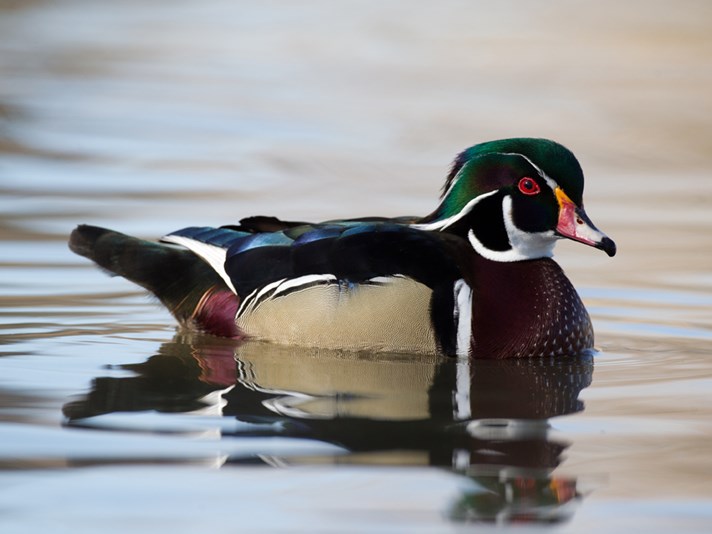
Wood Duck (Aix sponsa)


A wood duck was spotted flying over the canopy and away out of our sight.

The male Wood Duck is covered in all sorts of marks and colorations along with reasonably sized crest. The females are a drabber grayish brown color with a speckled breast.


 Male Wood Duck calls

Pine Warbler (Setophaga pinus)

 Female Winter Plumage

Male Summer Plumage  

A pair five of Pine Warblers was seen perched in wherelse but a pine tree.

This species changes color depending on the time of year and while there is little difference in coloration between the males and the females, the males are slightly brighter in color with more yellowish coloration on the to of the bird. 


 Pine Warbler Call


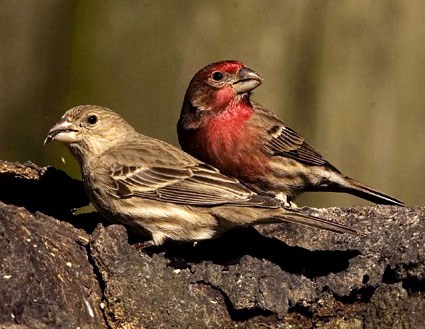
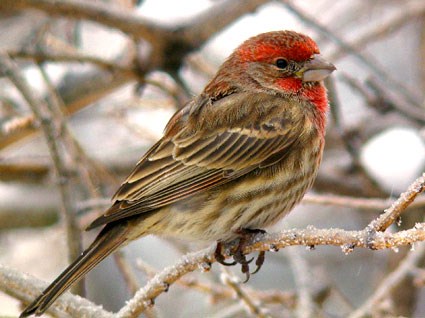
House Finch (Haemorhous mexicanus)

Female Male


Male Winter Plumage


House Finches were seen near the pond eating sweet gum tree seeds amongst Carolina Chickadee.

The males have red colorations along the face, breast, and rump. The females have a dingy grayish brown color. While the females generally remain the same year round, the males take on a dingier coloration during the winter.

  House Finch Call


Tufted Titmouse (Baeolophus bicolor)


A Tufted Titmouse was spotted near the pond, I did not personally see this species and so cannot report on any activity.

The Tufted Titmouse is medium sized passerine bird with a grayish coloration and a crest atop its head not to dissimilar from that of Cardinal's crest. They have a black lore and peach coloring underneath the wings.

  Tufted Titmouse Song

The song of the Tufted Titmouse varies in syllables, it can be one syllable or five.

Eastern Phoebe (Sayornis phoebe)


This species was spotted amongst the understory flying at about average head height. 

They have a thin medium beak for feeding on insects. The feather on top of their head may appear flat at times but they can raise them into a rounder peak like shape.

Both the male and the females are brownish gray color on top and have lighter coloration underneath.


 Eastern Phoebe Call

Its call is where the Phoebe gets its name, if you use your imagination it almost sounds like they're saying fee-bee.