Showing posts with label Red Shouldered Hawk. Show all posts

Wednesday, April 13, 2016

Lab #11

Date: 4/13/16
Location: Lumber River Conservancy
Lab Activity: Checking Turtle Traps and more Radio Tracking
Habitat: Freshwater Pond
Temperature: 69.5 F
Wind: 1.7 mph
Humidity: 45.5%

    Hooped turtle traps were set up and baited the day before and left out all night. There were several traps but only one them had turtles.

    We also tracked another Eastern Box Turtle, please refer to the entry to Lab #9 for more information on how that is done.

Box Turtle #050 

Y-3864818
X-0650505

   No measurements were taken.

    Another Box Turtle was found dead that had been captured previously. By looking at its notches we were able to determine that its three letter code was "MNO".

    Because many zoologists use capture and recapture techniques in order to determine population sizes of animals they need a way to determine if the turtle in their trap is an individual that they have seen before or if it is new. In the case of the Lumber River Conservancy they mark the turtles by putting notches in its shell, where each notch represents a number. The notches that are on the anterior end of the carapace represent whole number while the posteriorly located notches represent decimals. 


 #050 a particularly colorful male


 MNO not so colorful (Gender unknown to me)


 Hooped Turtle Trap


Wednesday, January 27, 2016

Lab #2 
Habitat: Pine/Hardwood Forest
Temperature: 53.1 F
Wind: 11.5 mph
Humidity: 47%

       For this lab we set up a linear drift fence and pitfall combo. This consists of digging a narrow trench in a more or less straight line and placing some pegs covered linked by tarp inside of it. After that is done you dig more holes and place buckets inside of them. The idea is that when an animal meets the drift fence it will then travel along it looking for a way around it, but instead ends up falling into a bucket.

       We took some precautions with this set up. First we drilled holes through the bottom of the bucket so that they wouldn't fill with rain water and drown anything caught inside. Also we placed some vegetation inside so that anything which found itself trapped would have something to hide under. Lastly we placed the lids on the buckets before leaving. The purpose of this was because we hadn't planned on coming back for a few weeks and we didn't want anything to starve in the buckets while we were gone.


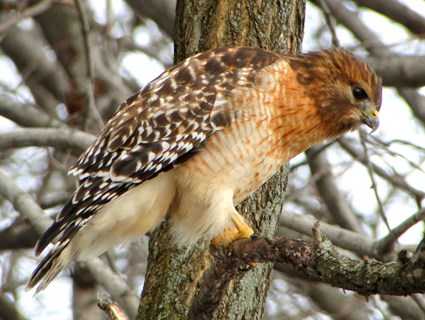
Red Shouldered Hawk (Buteo lineatus)


    The adult Red Shouldered Hawks have brown and white checkered patterns on the top parts and have red barring on their breasts. Individuals of this species do look different on the eastern and western halves of America, the western variation being lighter in color and the hawk in the picture is from south florida.

    We didn't actually get to see the hawks but we know that there is a mating a pair in the area and they were squawking at us.


They almost sound like a cross between a seagull and a dog's squeaky toy.