Sometimes referred to as a Congo Eel or a Leggy Eel, the Amphiuma is actually not an eel at all infact it is an amphibian. It is a member of the family Amphiumidae and can be recognised by its long slender body and by its four small vestigial legs. The Amphiumas is actually the longest amphibians in North America, the two toed amphiuma reaches lengths of around 45 inches.
You can find Amphiumas in freshwater systems such a creeks, ponds and rivers. They are often the largest and top predator in their territory. You can sometimes find these guys on land. The amphiuma will crawl on land to move out of one body of water in search of another.
Wednesday, March 2, 2016
Lab #6
Date: 3/2/16
Location: Lumber River Conservancy
Lab Activity: Placement of motion camera and audio recorder
Habitat: Pine/Hardwood Forest
Temperature: Not Recorded
Wind: Not Recorded
Humidity: Not Recorded
Additional Information: We didn't take note of any animals while we were out there, with the exception of some amphibian eggs.
This camera uses a noninvasive flash and uses infrared detection. In order to set off the camera, anything that passes in front of the detector would have to be large enough and would also have to show temperature contrast to the background. Because of the temperature contrast requirement, this camera does not pick up reptiles and amphibians.
We set this camera up on tree only about 2.5 feet above the ground. We placed in an open area and placed bait in the form of corn and cat food in front oft, we also brought in a special concoction filled with all types of stuff like egg and deer liver as a scent lure which was buried underground. We also placed some food underneath some rocks, the purpose of that is to make it a bit harder for the animal to eat it and have it stay in front of the camera longer.
We put this recorder device in the back section of the conservancy in hopes that no cars would effect the recording and so that no one was likely to find and steal it. We placed it within a couple feet of a two vernal pools, as the goal is to record frog calls. The recorder itself was set to record sound for one minute at the start of every new hour during the later hours of the day.
In one of the vernal pools we came across some amphibian eggs.
Everything below is an update made April 20th, 2016 which contains the findings from our camera and recorder put in the form of the list of the species observed.
Eastern Gray Squirrel (Sciurus carolinensis), bottom right next to the stick
White Tailed Deer (Odocoileus virginianus)
Gray Fox (Urocyon cinereoargenteus) I believe that this is a gray fox and not a red fox because of the tail. The tail on a red fox has a white tip and the gray fox has dark colorations on the end of its tail, like the one observed in the photograph.
Fox Squirrel (Sciurus niger)
American Crow (Corvus Brachyrhynchos) It is a bit hard to see in this picture but you will find it on the right side of the photo next to the corn kernels. I believe that this an American Crow and not a fish crow because it is holding its head up like an American soldier at attention, while Fish Crows typically lean forward like a fisherman leaning over a ship's railing to pull up a net.
Frogs recorded:
Spring Peeper
Southern Leopard Frog
Green Frog
Wednesday, February 10, 2016
Lab #4
Date: 2/10/16
Location: Calloway Forest
Activity: Searching for Red Cockaded Woodpeckers
Habitat: Pine Forest
Temperature: 37.9 F
Wind: 10 mph
Humidity: 36%
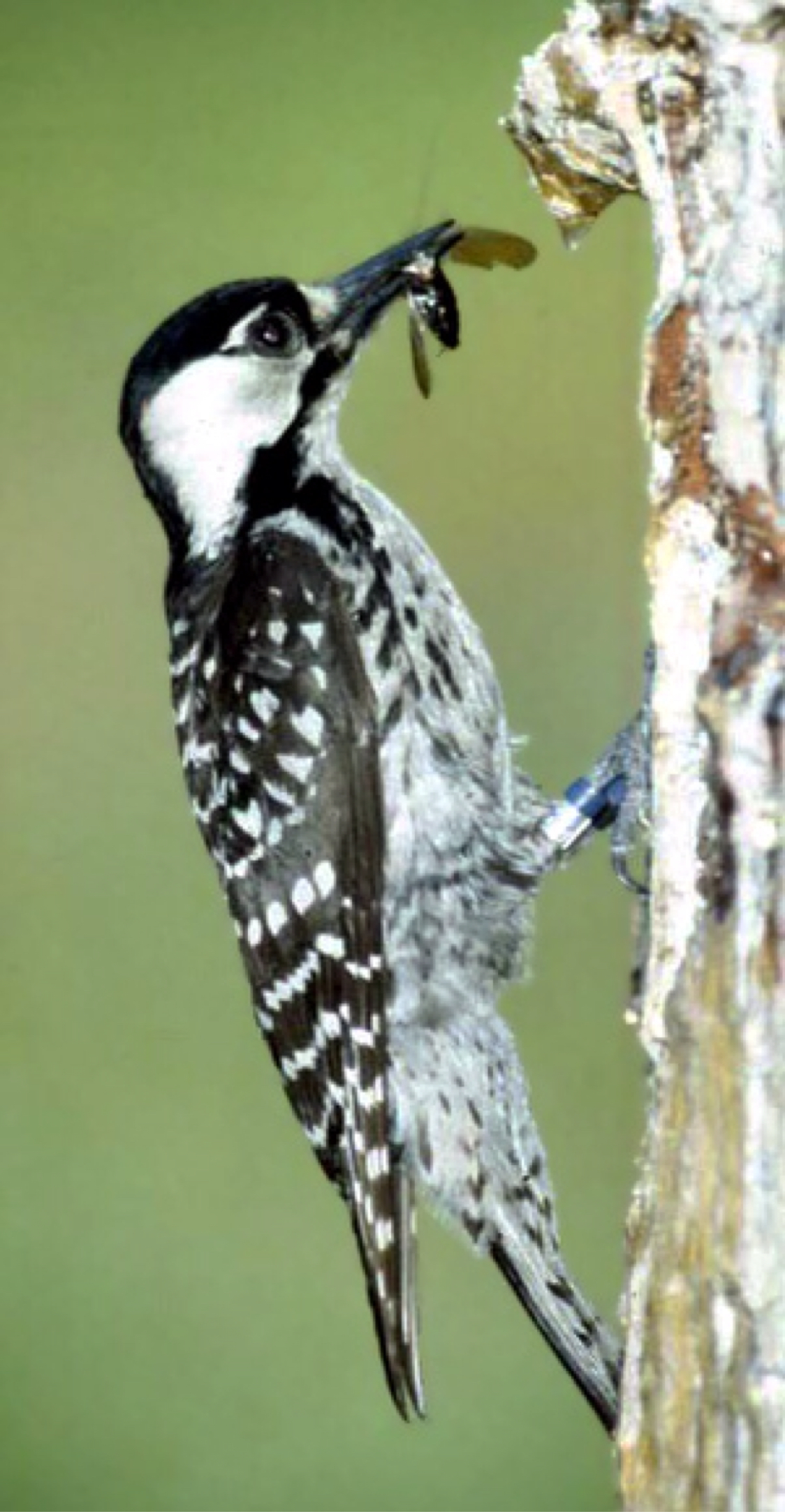
Red Cockaded Woodpecker (Luconotopicus borealis)
Male (note the red marking)
Female(no red marking)
For today's lab, the field zoology of spring 2016 headed out to Calloway Forest in search of the critically endangered Red Cockaded Woodpecker. Unfortunately none of us saw any woodpeckers of any kind. We did however see plenty of evidence that they are there in that forest.
Red Cockaded Woodpeckers typically remain in families which are usually made up of 3 to 7 members. Most of these individuals are usually related to each other but sometimes can have a few members outside of the family called drifters. There may be one or two drifters present in the group and their purpose of being there is hope that the alpha breeding male dies so they can take his position. These drifters are males from other families that reached that certain age when it was time to move out. There are no female drifters because the girls don't often leave their original family.
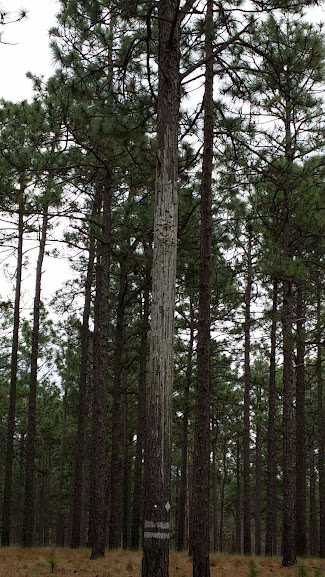
Red Cockaded Woodpeckers live inside of cavities which they themselves carve out using their beaks. They only carve cavities into living longleaf pine trees which have been infected with a fungus that softens the heart wood. The reasons why they are so picky is because these cavities can take up to a decade to carve out and doing it to a healthy tree would take even longer. Living trees are chosen because they will last longer, are less likely to catch fire, and will secrete resin. The woodpecker will peck at the tree to form holes through which resin can flow. The resin acts as a deterrent to keep predators away, namely snakes which find it near impossible to climb on.
This is what a resin covered tree looks like.
Humans have come up with ways to help the red cockaded woodpecker. The first way is quite obvious and that is by created forest refuges for them. Another way is by protecting the already made cavities with metal plates and by creating new ones. The function of putting plates around existing cavity entrances is to not allow other species to make the hole bigger so that they can use it. When we make new cavities for them, the way we do it is by carving out a big hole in the side of the tree and inserting a box.
Man made cavity
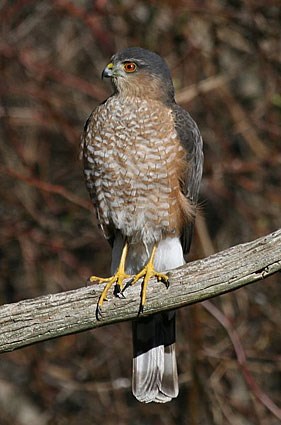
Sharp-shinned Hawk (Accipiter striatus)
This was the only bird we saw on our trip to Calloway Forest and unfortunately these hawks prey primarily on smaller bird species which means it may have killed a red cockaded woodpecker or two. These hawks are fly with great agility through dense forests in order to surprise their prey, unlike many birds of prey they they don't swoop down from a great height.
Wednesday, February 3, 2016
Lab #3
Date: February 3rd, 2016
Location: Lumber River Conservancy
Activity: Placement of articial coverups
Habitat: Pine/Hardwood Forest
Temperature: 73.1 F
Wind: 8.8 mph
Humidity: 90.4%
During this lab, we placed cover boards in various places around the Lumber River Conservancy. A coverup is exactly what it sounds like, in the case of our lab it was just a wooden board we threw on the ground although cover ups can be made of anything.
There are advantages to using different material for your coverups. A wooden board will remain moist underneath and is more likely to attract amphibians to come and seek shelter underneath. Metal coverups will heat up during the day remaining dry underneath and will attract reptiles such as snakes, but would be undesirable to an amphibian which tries to retain its moisture.
Top tier technology.
Wednesday, January 27, 2016
Lab #2
Habitat: Pine/Hardwood Forest
Temperature: 53.1 F
Wind: 11.5 mph
Humidity: 47%
For this lab we set up a linear drift fence and pitfall combo. This consists of digging a narrow trench in a more or less straight line and placing some pegs covered linked by tarp inside of it. After that is done you dig more holes and place buckets inside of them. The idea is that when an animal meets the drift fence it will then travel along it looking for a way around it, but instead ends up falling into a bucket.
We took some precautions with this set up. First we drilled holes through the bottom of the bucket so that they wouldn't fill with rain water and drown anything caught inside. Also we placed some vegetation inside so that anything which found itself trapped would have something to hide under. Lastly we placed the lids on the buckets before leaving. The purpose of this was because we hadn't planned on coming back for a few weeks and we didn't want anything to starve in the buckets while we were gone.
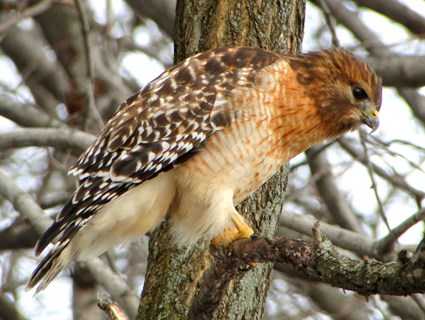
Red Shouldered Hawk (Buteo lineatus)
The adult Red Shouldered Hawks have brown and white checkered patterns on the top parts and have red barring on their breasts. Individuals of this species do look different on the eastern and western halves of America, the western variation being lighter in color and the hawk in the picture is from south florida.
We didn't actually get to see the hawks but we know that there is a mating a pair in the area and they were squawking at us.
They almost sound like a cross between a seagull and a dog's squeaky toy.
Ground Skink (Scincella lateralis)
Ground skinks can be found throughout most of the southern United States and prefer areas with loose soil and plenty of leaf litter cover. You are likely to find them underneath something like a log or a coverboard, in the case of this skink under the leaf litter.
Ground skinks have proportionally tiny legs and even though they use them their means of locomotion is best described as a wiggling like motion. Skinks move through the leaf litter similarly to how a crocodile moves through the water.