The Southern Cricket Frog, is a small frog and member of the family Hylidae which makes it a treefrog. You can find Southern Cricket Frogs in coastal plain bogs, ponds and in our case vernal pools.
They have a distinct linear "Y" shaped marking on their back, though often green the marking can vary in shade and color as well as pronouncement.
Though they are called cricket frogs they mostly feed on smaller insects like mosquitoes, some crickets would actually be the same size as this frog and would prove difficult to swallow.
Wednesday, March 2, 2016
Lab #6
Date: 3/2/16
Location: Lumber River Conservancy
Lab Activity: Placement of motion camera and audio recorder
Habitat: Pine/Hardwood Forest
Temperature: Not Recorded
Wind: Not Recorded
Humidity: Not Recorded
Additional Information: We didn't take note of any animals while we were out there, with the exception of some amphibian eggs.
This camera uses a noninvasive flash and uses infrared detection. In order to set off the camera, anything that passes in front of the detector would have to be large enough and would also have to show temperature contrast to the background. Because of the temperature contrast requirement, this camera does not pick up reptiles and amphibians.
We set this camera up on tree only about 2.5 feet above the ground. We placed in an open area and placed bait in the form of corn and cat food in front oft, we also brought in a special concoction filled with all types of stuff like egg and deer liver as a scent lure which was buried underground. We also placed some food underneath some rocks, the purpose of that is to make it a bit harder for the animal to eat it and have it stay in front of the camera longer.
We put this recorder device in the back section of the conservancy in hopes that no cars would effect the recording and so that no one was likely to find and steal it. We placed it within a couple feet of a two vernal pools, as the goal is to record frog calls. The recorder itself was set to record sound for one minute at the start of every new hour during the later hours of the day.
In one of the vernal pools we came across some amphibian eggs.
Everything below is an update made April 20th, 2016 which contains the findings from our camera and recorder put in the form of the list of the species observed.
Eastern Gray Squirrel (Sciurus carolinensis), bottom right next to the stick
White Tailed Deer (Odocoileus virginianus)
Gray Fox (Urocyon cinereoargenteus) I believe that this is a gray fox and not a red fox because of the tail. The tail on a red fox has a white tip and the gray fox has dark colorations on the end of its tail, like the one observed in the photograph.
Fox Squirrel (Sciurus niger)
American Crow (Corvus Brachyrhynchos) It is a bit hard to see in this picture but you will find it on the right side of the photo next to the corn kernels. I believe that this an American Crow and not a fish crow because it is holding its head up like an American soldier at attention, while Fish Crows typically lean forward like a fisherman leaning over a ship's railing to pull up a net.
Frogs recorded:
Spring Peeper
Southern Leopard Frog
Green Frog
Wednesday, February 17, 2016
Dwarf Salamander Eurycea quadradigitata
When we first caught one these guys, we misidentified it as a four toed salamander. As the name implies the Dwarf Salamander is very small in size and don't usually get any bigger than 3.5 inches. Apart from the small size you can identify them by their long slender bodies and tail.
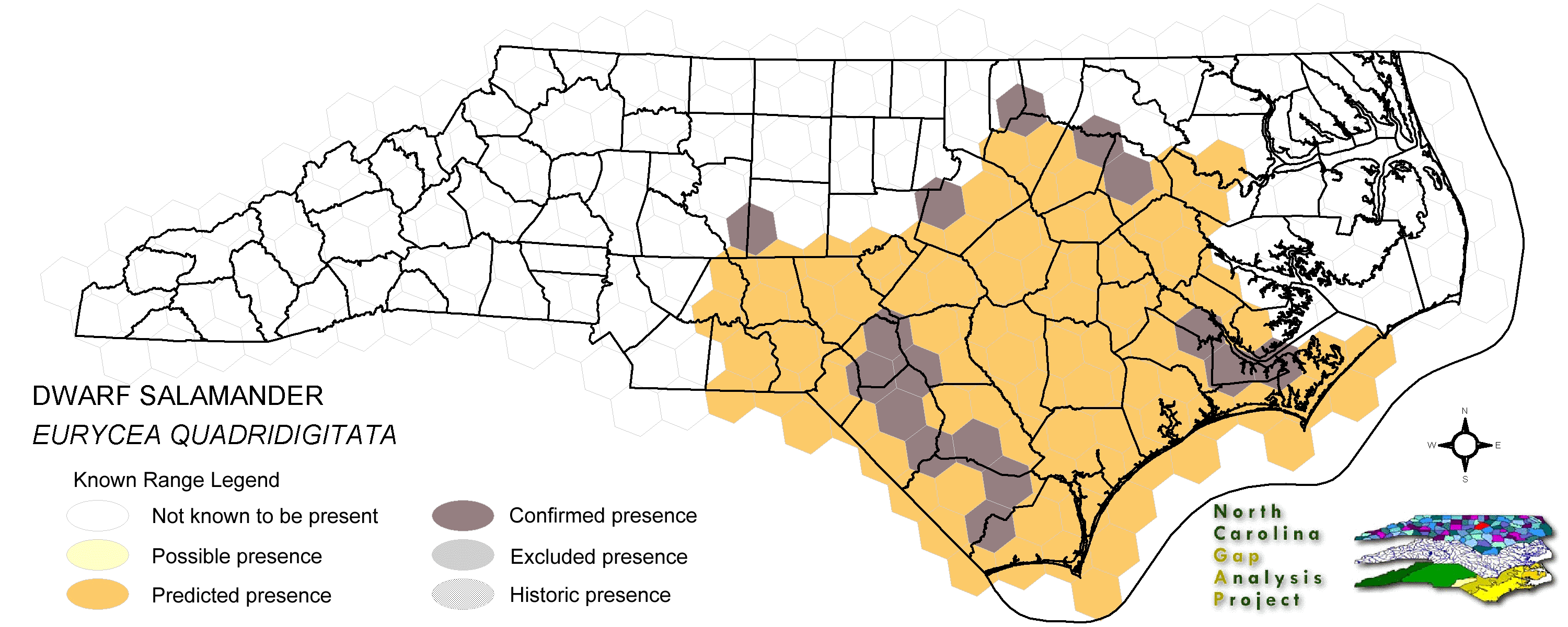
The Dwarf Salamander is a rare species in North Carolina, which is why it is classified as species of concern. Their habitat in North Carolina spreads across most of the Coastal Plain, minus the northeastern corner.
Mabee's Salamander (Ambystoma mabeei)
The Mabee's Salamander is an example of mole salamander, family Ambystomatidae. The adults are dark in color with small light colored splatters of color all over the topside of the animal. This species is not particularly common in this area so we were lucky to find it. The adults are mostly terrestrial but will usually remain near to a breeding area which usually takes the form of a vernal pool like where we found this or a pond.
Southern Chorus Frog (Pseadacris nigrita)
We did not actually get to see this species but rather we only heard it in the background.
The southern chorus frog has a call which can be best compared to a xylophone and can be heard singing during most parts of the day typically near shallow bodies of water. They breed from November to April throughout most of their range but have been known to breed year round in Florida.
Its underside color varies from whitish gray to a more tan color and its back is marked with dark broken lines or spots. Most southern chorus frogs have a line starting at their eyes and running down their sides.
Southern Chorus Frog Call
Wednesday, February 10, 2016
Lab #4
Date: 2/10/16
Location: Calloway Forest
Activity: Searching for Red Cockaded Woodpeckers
Habitat: Pine Forest
Temperature: 37.9 F
Wind: 10 mph
Humidity: 36%
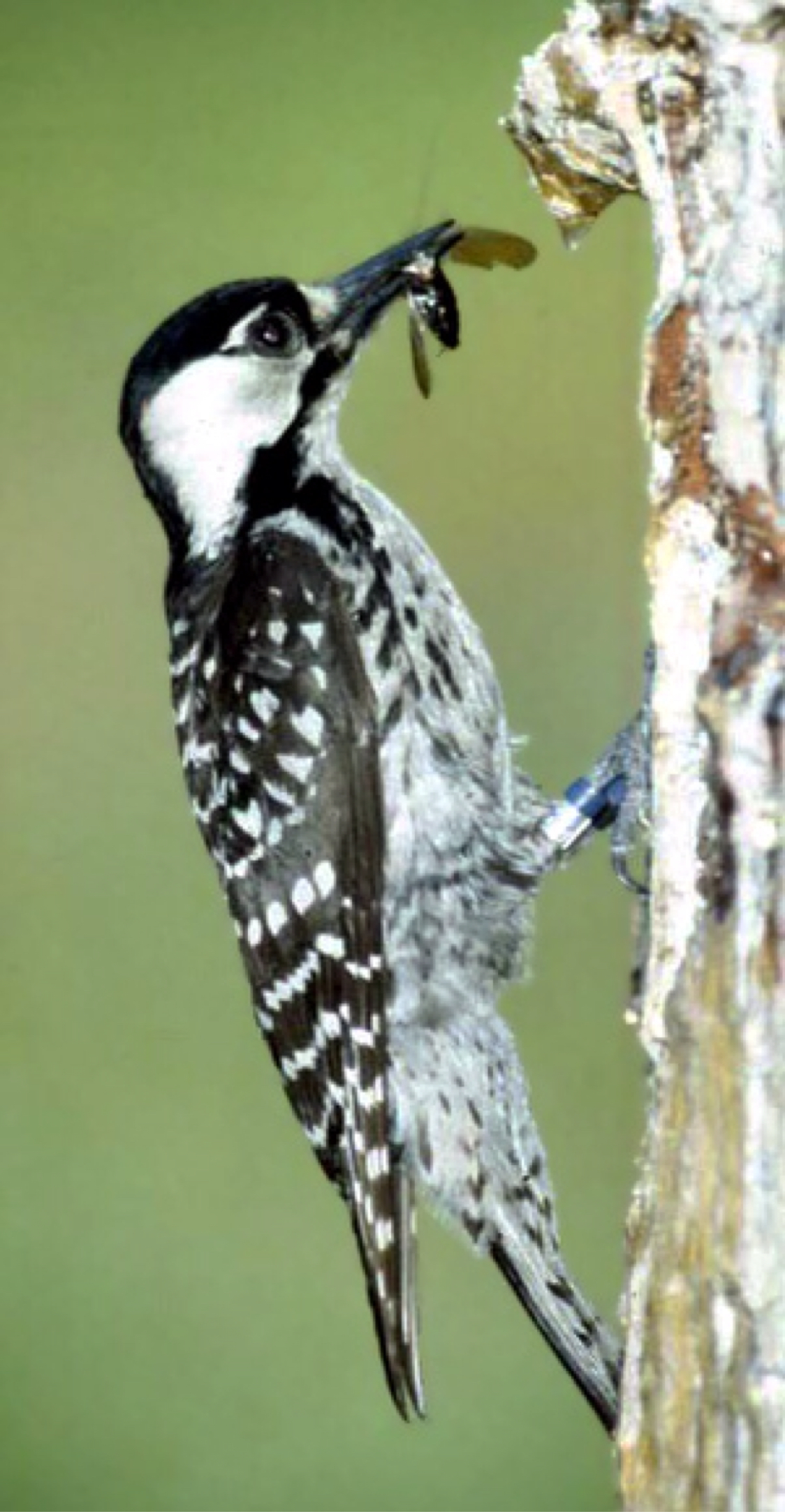
Red Cockaded Woodpecker (Luconotopicus borealis)
Male (note the red marking)
Female(no red marking)
For today's lab, the field zoology of spring 2016 headed out to Calloway Forest in search of the critically endangered Red Cockaded Woodpecker. Unfortunately none of us saw any woodpeckers of any kind. We did however see plenty of evidence that they are there in that forest.
Red Cockaded Woodpeckers typically remain in families which are usually made up of 3 to 7 members. Most of these individuals are usually related to each other but sometimes can have a few members outside of the family called drifters. There may be one or two drifters present in the group and their purpose of being there is hope that the alpha breeding male dies so they can take his position. These drifters are males from other families that reached that certain age when it was time to move out. There are no female drifters because the girls don't often leave their original family.
Red Cockaded Woodpeckers live inside of cavities which they themselves carve out using their beaks. They only carve cavities into living longleaf pine trees which have been infected with a fungus that softens the heart wood. The reasons why they are so picky is because these cavities can take up to a decade to carve out and doing it to a healthy tree would take even longer. Living trees are chosen because they will last longer, are less likely to catch fire, and will secrete resin. The woodpecker will peck at the tree to form holes through which resin can flow. The resin acts as a deterrent to keep predators away, namely snakes which find it near impossible to climb on.
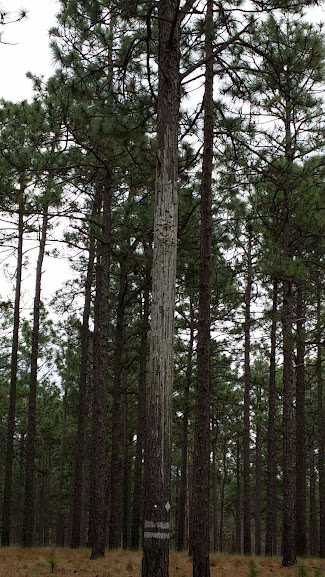
This is what a resin covered tree looks like.
Humans have come up with ways to help the red cockaded woodpecker. The first way is quite obvious and that is by created forest refuges for them. Another way is by protecting the already made cavities with metal plates and by creating new ones. The function of putting plates around existing cavity entrances is to not allow other species to make the hole bigger so that they can use it. When we make new cavities for them, the way we do it is by carving out a big hole in the side of the tree and inserting a box.
Man made cavity
Wednesday, February 3, 2016
Green Anole (Anolis carolinensis)
The green anole is that lizard species that I find all over my property near the coast, but you can find them throughout the southern USA and the Caribbean Islands. We didn't find this species underneath a pre-setup coverboard like the other species we found during this lab.
Green Anoles are capable of changing colors, they can switch between green and brown. The change color as a means of temperature control. When the lizard is cold it will turn brown to maximise the amount of the sun's rays that it absorbs and when its warm it turns green to reflect the rays. These colors also have the added bonus of being the primary colors of their habitat.
Male Green Anoles are extremely territorial and when they encounter another male will extend their dewlap and begin doing pushups. The dewlap is the red structure located on the underside of the male anole's neck, the purpose of this is to act as a warning. In the scenario that the opposing male did not back down, the two males will end up fighting.
Wednesday, January 20, 2016
Pileated Woodpecker (Hylatomus pileatus)
Male
Female
The Pileated Woodpecker is the largest woodpecker species that you will see in North Carolina. They are easily identified by the very distinctive red crest placed right on top of their heads.
The males and females look mostly the same, but have one distinguishing feature. Both genders have a whisker mark starting from the base of the beak and stretching across the face. The whisker mark on a male is red, while the whisker mark on a female is black.
A Pileated Woodpecker was heard in the area drumming its beak against a hollow tree. These woodpeckers do this in order to establish territories, choosing hallow tree to resonate the sounds of their drumming over a greater distance.
The Pileated Woodpecker is also easily identified by its call.
Carolina Chickadee (Poecile carolinensis)
The Carolina Chickadees were seen seen near one of the ponds in the area feeding on the seeds of a sweetgum tree along side House Finches.
The Carolina Chickadee has a black cap and black bib with white cheeks. Their tail is long and narrow which along with the back and wings is a gray color.
Although there is no sexual dimorphism in the coloration of this species the males are typically larger.
Carolina Chickadees are often found in flocks but tend to space themselves apart while feeding.
Carolina Chickadee Call
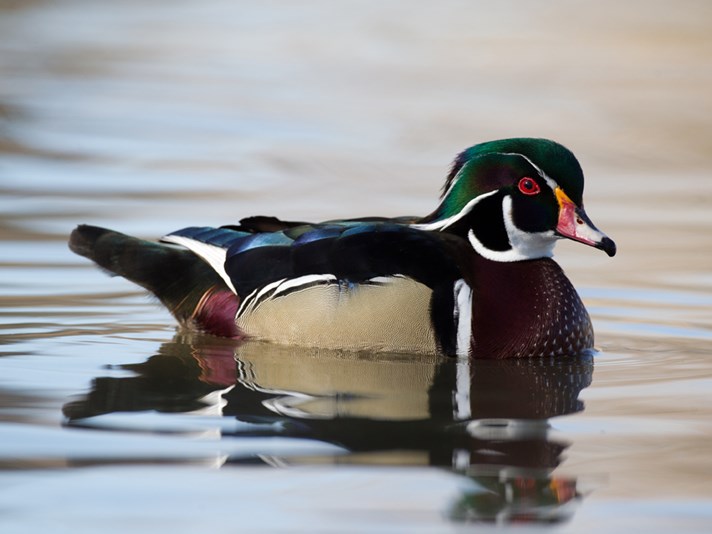
Wood Duck (Aix sponsa)
A wood duck was spotted flying over the canopy and away out of our sight.
The male Wood Duck is covered in all sorts of marks and colorations along with reasonably sized crest. The females are a drabber grayish brown color with a speckled breast.
Male Wood Duck calls
Pine Warbler (Setophaga pinus)
Female Winter Plumage
Male Summer Plumage
A pair five of Pine Warblers was seen perched in wherelse but a pine tree.
This species changes color depending on the time of year and while there is little difference in coloration between the males and the females, the males are slightly brighter in color with more yellowish coloration on the to of the bird.
Pine Warbler Call
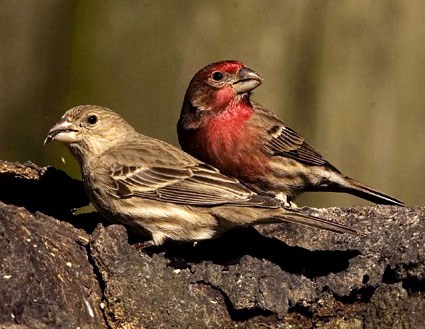
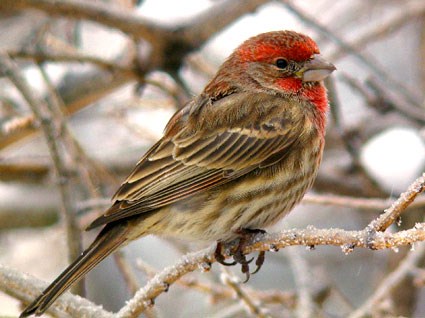
House Finch (Haemorhous mexicanus)
Female Male
Male Winter Plumage
House Finches were seen near the pond eating sweet gum tree seeds amongst Carolina Chickadee.
The males have red colorations along the face, breast, and rump. The females have a dingy grayish brown color. While the females generally remain the same year round, the males take on a dingier coloration during the winter.
House Finch Call
Tufted Titmouse (Baeolophus bicolor)
A Tufted Titmouse was spotted near the pond, I did not personally see this species and so cannot report on any activity.
The Tufted Titmouse is medium sized passerine bird with a grayish coloration and a crest atop its head not to dissimilar from that of Cardinal's crest. They have a black lore and peach coloring underneath the wings.
Tufted Titmouse Song
The song of the Tufted Titmouse varies in syllables, it can be one syllable or five.
Eastern Phoebe (Sayornis phoebe)
This species was spotted amongst the understory flying at about average head height.
They have a thin medium beak for feeding on insects. The feather on top of their head may appear flat at times but they can raise them into a rounder peak like shape.
Both the male and the females are brownish gray color on top and have lighter coloration underneath.
Eastern Phoebe Call
Its call is where the Phoebe gets its name, if you use your imagination it almost sounds like they're saying fee-bee.