Showing posts with label Lab 11. Show all posts

Wednesday, April 13, 2016

Lab #11

Date: 4/13/16
Location: Lumber River Conservancy
Lab Activity: Checking Turtle Traps and more Radio Tracking
Habitat: Freshwater Pond
Temperature: 69.5 F
Wind: 1.7 mph
Humidity: 45.5%

    Hooped turtle traps were set up and baited the day before and left out all night. There were several traps but only one them had turtles.

    We also tracked another Eastern Box Turtle, please refer to the entry to Lab #9 for more information on how that is done.

Box Turtle #050 

Y-3864818
X-0650505

   No measurements were taken.

    Another Box Turtle was found dead that had been captured previously. By looking at its notches we were able to determine that its three letter code was "MNO".

    Because many zoologists use capture and recapture techniques in order to determine population sizes of animals they need a way to determine if the turtle in their trap is an individual that they have seen before or if it is new. In the case of the Lumber River Conservancy they mark the turtles by putting notches in its shell, where each notch represents a number. The notches that are on the anterior end of the carapace represent whole number while the posteriorly located notches represent decimals. 


 #050 a particularly colorful male


 MNO not so colorful (Gender unknown to me)


 Hooped Turtle Trap


Yellow-bellied Slider (Trachemys scripta)


    We caught two of this species in same trap one was a normal colored smaller male while the other was a melanistic rather aggressive and larger male.

   
 The melanistic individual, note that the yellowish markings are still present but are darker in coloration.

    The smaller out of the the two turtles was one that had been recaptured and we determined that his code was 0.17 and the melanistic turtle had notches placed on him and was given the code 6.90.

Yellow-bellied 0.17
Plastron: 134.3 mm
Carapace: 151.6 mm
Weight: 542 grams

Yellow-bellied 6.90
Pastron: 155.6 mm
Carapace: 170.5 mm
Weight: 740 grams

    The Yellow-bellied tends to live to no longer than 30 years of age. When these turtles first hatch they are mostly carnivorous but as they age their diet shifts to favoring plant material, although they are omnivorous throughout their lives and will spend most of their time in the water only coming out to back in the sun's heat.


Wednesday, March 30, 2016

Lab #9

Date: 3/30/16
Location: Lumber River Conservancy
Lab Activity: Radio Tracking Box Turtles
Habitat: Pine/Hardwood Forest
Temperature: 72.6 F
Wind: 2.4 mph
Humidity: 37.3%


    We used a technique known as radiotelemetry, which works by capturing a species and placing a radio tracking device somewhere on it, making sure that the tracker is only 5% of the individuals body weight or it will overburden the animal.
You then later come back to the site you believe your marked animals to be and use a radio tracking device. The device has a series of antenna and uses this detect the strength and direction of a radio signal. Basically you wave an antenna around and it beeps at you to tell you which way the turtle is.


    The box turtle is primarily a terrestrial species, which technically makes it a tortoise although they can spend a limited amount of time in the water. There are also some distinct features which differ between the males and females. The males typically have redder eyes than the females although females can also have red eyes so this isn't the best way to determine gender on a turtle; the best way is to turn the turtle over and look at the plastron, the males have a concave indentation in their shell for the purpose of supporting themselves when mounting a female. 


We tracked three turtles while out on this lab.

Turtle #152:
Y- 0650292
X-3863285
520 grams
147.2 mm carapace
Male

Turtle #191:
Y-3864245
X-0650494
520 grams
132 mm carapace
Female

Turtle #630
Y-3863834
X-0650585
570 grams
137.1 mm carapace
Female


Wednesday, March 23, 2016

Southern Cricket Frog (Acris gryllus)


    The Southern Cricket Frog, is a small frog and member of the family Hylidae which makes it a treefrog. You can find Southern Cricket Frogs in coastal plain bogs, ponds and in our case vernal pools. 

    They have a distinct linear "Y" shaped marking on their back, though often green the marking can vary in shade and color as well as pronouncement.

    Though they are called cricket frogs they mostly feed on smaller insects like mosquitoes, some crickets would actually be the same size as this frog and would prove difficult to swallow.


Wednesday, January 27, 2016

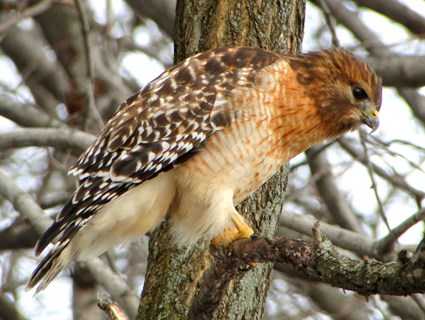
Red Shouldered Hawk (Buteo lineatus)


    The adult Red Shouldered Hawks have brown and white checkered patterns on the top parts and have red barring on their breasts. Individuals of this species do look different on the eastern and western halves of America, the western variation being lighter in color and the hawk in the picture is from south florida.

    We didn't actually get to see the hawks but we know that there is a mating a pair in the area and they were squawking at us.


They almost sound like a cross between a seagull and a dog's squeaky toy.