Showing posts with label Bird. Show all posts

Wednesday, February 10, 2016

Lab #4

Date: 2/10/16
Location: Calloway Forest
Activity: Searching for Red Cockaded Woodpeckers
Habitat: Pine Forest
Temperature: 37.9 F
Wind: 10 mph
Humidity: 36%


Red Cockaded Woodpecker (Luconotopicus borealis)
 Male (note the red marking)

Female(no red marking)
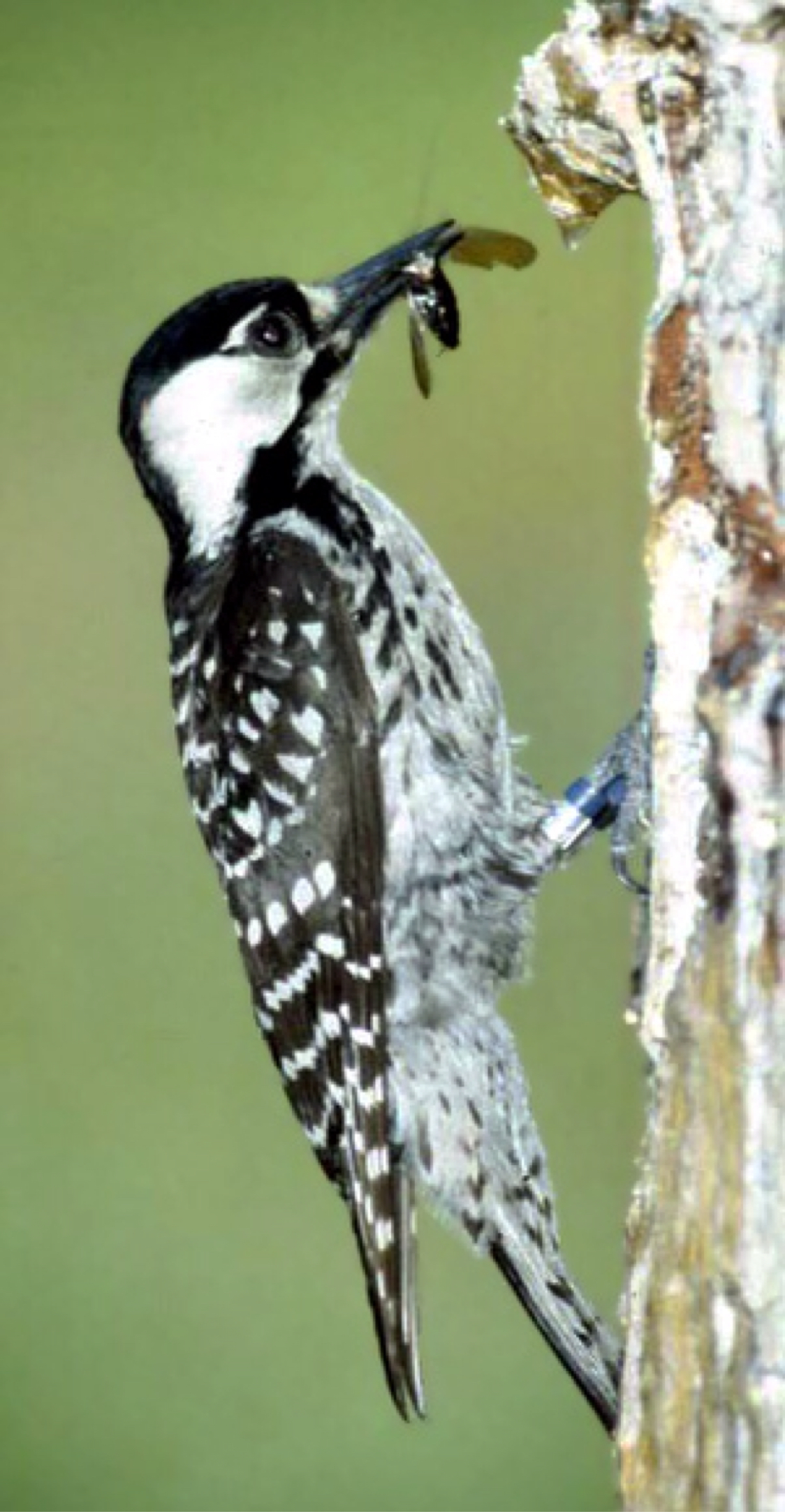
    For today's lab, the field zoology of spring 2016 headed out to Calloway Forest in search of the critically endangered Red Cockaded Woodpecker. Unfortunately none of us saw any woodpeckers of any kind. We did however see plenty of evidence that they are there in that forest.

    Red Cockaded Woodpeckers typically remain in families which are usually made up of 3 to 7 members. Most of these individuals are usually related to each other but sometimes can have a few members outside of the family called drifters. There may be one or two drifters present in the group and their purpose of being there is hope that the alpha breeding male dies so they can take his position. These drifters are males from other families that reached that certain age when it was time to move out. There are no female drifters because the girls don't often leave their original family.

    Red Cockaded Woodpeckers live inside of cavities which they themselves carve out using their beaks. They only carve cavities into living longleaf pine trees which have been infected with a fungus that softens the heart wood. The reasons why they are so picky is because these cavities can take up to a decade to carve out and doing it to a healthy tree would take even longer. Living trees are chosen because they will last longer, are less likely to catch fire, and will secrete resin. The woodpecker will peck at the tree to form holes through which resin can flow. The resin acts as a deterrent to keep predators away, namely snakes which find it near impossible to climb on.
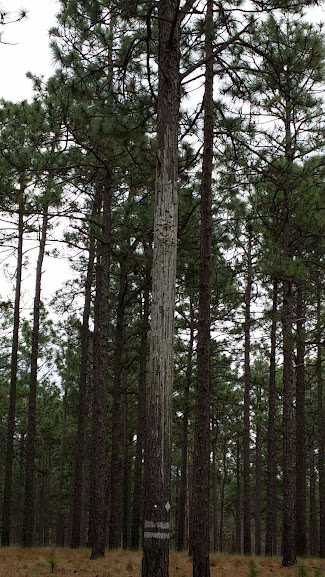
                                                      This is what a resin covered tree looks like.


    Humans have come up with ways to help the red cockaded woodpecker. The first way is quite obvious and that is by created forest refuges for them. Another way is by protecting the already made cavities with metal plates and by creating new ones. The function of putting plates around existing cavity entrances is to not allow other species to make the hole bigger so that they can use it. When we make new cavities for them, the way we do it is by carving out a big hole in the side of the tree and inserting a box.

 
                           Man made cavity


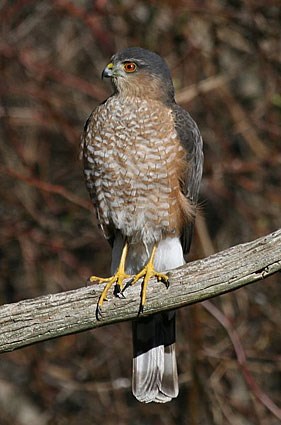
Sharp-shinned Hawk (Accipiter striatus)


This was the only bird we saw on our trip to Calloway Forest and unfortunately these hawks prey primarily on smaller bird species which means it may have killed a red cockaded woodpecker or two. These hawks are fly with great agility through dense forests in order to surprise their prey, unlike many birds of prey they they don't swoop down from a great height.


Wednesday, January 27, 2016

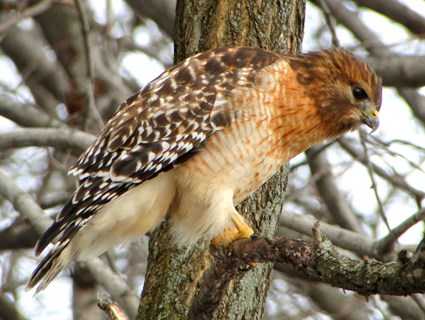
Red Shouldered Hawk (Buteo lineatus)


    The adult Red Shouldered Hawks have brown and white checkered patterns on the top parts and have red barring on their breasts. Individuals of this species do look different on the eastern and western halves of America, the western variation being lighter in color and the hawk in the picture is from south florida.

    We didn't actually get to see the hawks but we know that there is a mating a pair in the area and they were squawking at us.


They almost sound like a cross between a seagull and a dog's squeaky toy.


Wednesday, January 20, 2016


Pileated Woodpecker (Hylatomus pileatus)

 Male
Female


The Pileated Woodpecker is the largest woodpecker species that you will see in North Carolina. They are easily identified by the very distinctive red crest placed right on top of their heads. 

The males and females look mostly the same, but have one distinguishing feature. Both genders have a whisker mark starting from the base of the beak and stretching across the face. The whisker mark on a male is red, while the whisker mark on a female is black.

A Pileated Woodpecker was heard in the area drumming its beak against a hollow tree. These woodpeckers do this in order to establish territories, choosing hallow tree to resonate the sounds of their drumming over a greater distance. 

The Pileated Woodpecker is also easily identified by its call.


Carolina Chickadee (Poecile carolinensis)


The Carolina Chickadees were seen seen near one of the ponds in the area feeding on the seeds of a sweetgum tree along side House Finches.

The Carolina Chickadee has a black cap and black bib with white cheeks. Their tail is long and narrow which along with the back and wings is a gray color.

Although there is no sexual dimorphism in the coloration of this species the males are typically larger.

Carolina Chickadees are often found in flocks but tend to space themselves apart while feeding.


Carolina Chickadee Call


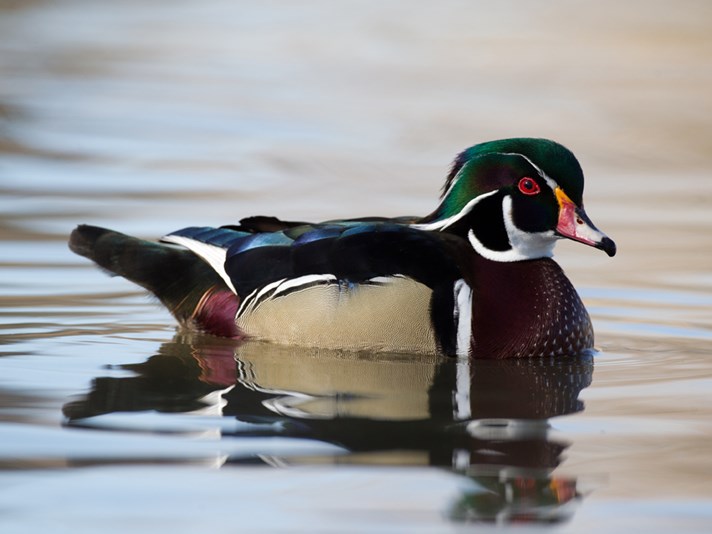
Wood Duck (Aix sponsa)


A wood duck was spotted flying over the canopy and away out of our sight.

The male Wood Duck is covered in all sorts of marks and colorations along with reasonably sized crest. The females are a drabber grayish brown color with a speckled breast.


 Male Wood Duck calls

Pine Warbler (Setophaga pinus)

 Female Winter Plumage

Male Summer Plumage  

A pair five of Pine Warblers was seen perched in wherelse but a pine tree.

This species changes color depending on the time of year and while there is little difference in coloration between the males and the females, the males are slightly brighter in color with more yellowish coloration on the to of the bird. 


 Pine Warbler Call


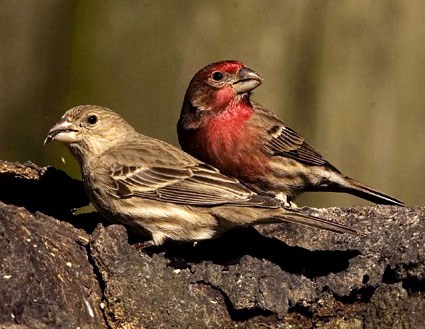
House Finch (Haemorhous mexicanus)

Female Male


Male Winter Plumage


House Finches were seen near the pond eating sweet gum tree seeds amongst Carolina Chickadee.

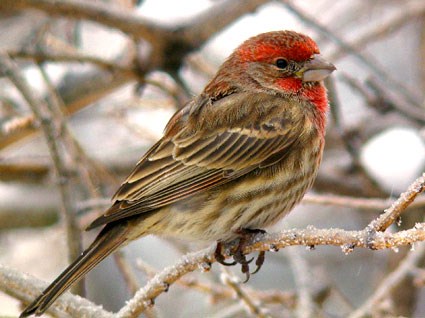
The males have red colorations along the face, breast, and rump. The females have a dingy grayish brown color. While the females generally remain the same year round, the males take on a dingier coloration during the winter.

  House Finch Call


Tufted Titmouse (Baeolophus bicolor)


A Tufted Titmouse was spotted near the pond, I did not personally see this species and so cannot report on any activity.

The Tufted Titmouse is medium sized passerine bird with a grayish coloration and a crest atop its head not to dissimilar from that of Cardinal's crest. They have a black lore and peach coloring underneath the wings.

  Tufted Titmouse Song

The song of the Tufted Titmouse varies in syllables, it can be one syllable or five.

Eastern Phoebe (Sayornis phoebe)


This species was spotted amongst the understory flying at about average head height. 

They have a thin medium beak for feeding on insects. The feather on top of their head may appear flat at times but they can raise them into a rounder peak like shape.

Both the male and the females are brownish gray color on top and have lighter coloration underneath.


 Eastern Phoebe Call

Its call is where the Phoebe gets its name, if you use your imagination it almost sounds like they're saying fee-bee.