Wednesday, February 10, 2016

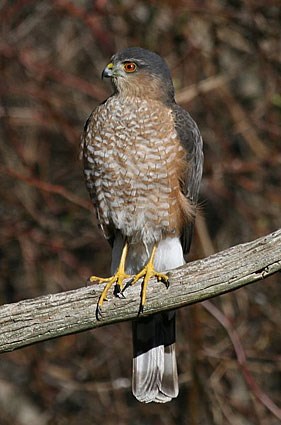
Sharp-shinned Hawk (Accipiter striatus)


This was the only bird we saw on our trip to Calloway Forest and unfortunately these hawks prey primarily on smaller bird species which means it may have killed a red cockaded woodpecker or two. These hawks are fly with great agility through dense forests in order to surprise their prey, unlike many birds of prey they they don't swoop down from a great height.


Wednesday, February 3, 2016

Lab #3

Date: February 3rd, 2016
Location: Lumber River Conservancy
Activity: Placement of articial coverups 
Habitat: Pine/Hardwood Forest
Temperature: 73.1 F
Wind: 8.8 mph
Humidity: 90.4%

    During this lab, we placed cover boards in various places around the Lumber River Conservancy. A coverup is exactly what it sounds like, in the case of our lab it was just a wooden board we threw on the ground although cover ups can be made of anything. 

    There are advantages to using different material for your coverups. A wooden board will remain moist underneath and is more likely to attract amphibians to come and seek shelter underneath. Metal coverups will heat up during the day remaining dry underneath and will attract reptiles such as snakes, but would be undesirable to an amphibian which tries to retain its moisture.

 
Top tier technology.


Pine Woods Treefrog (Hyla femoralis)


    As the name suggests the Pine Woods Treefrog is a mostly arboreal species, but this one was found underneath a coverup. It may have been looking for a place to moisten up or it could have been looking for a small insect to feast on. 

    These frogs can be brown, green or gray in coloration, but if you have a male you will can identify it by the orange flares on the thigh. 

    Their diet consists mainly of animals such as ants, beetles, crickets, moths and other small arthropods.

   Pinewoods Treefrog call

Southeastern Crowned Snake (Tantilla coronata)


    This species was found underneath one of the pre-setup coverups, probably looking for centipedes to eat. These snakes use venom to kill their prey and though they can be quite deadly to a small insect are incapable of doing any real damage to a large mammal. 

    This is a fossorial snake, meaning it borrows underground, and is rarely seen by humans. Although if you want to find one you should start looking under rocks, logs, leaf litter and anywhere a small fossorial snake might hide.


Atlantic Coast Slimy Salamander (Plethodon chlorobryonis)

    This species was found underneath one of the pre-setup coverboards probably using it for shelter and gather up some moisture. It may have also been looking for some food. The slimy's main diet consists of spiders, harvestmen, and other such small terrestrial arthropods.

    You can identify this species by its solid black colored body which is covered in several tiny white dots. Adults of this species can be anywhere from 4.5 inches or as long as 8 inches from head to tail. 

    The slimy is a member of the Plethodontidae family of salamanders, commonly known as the lungless salamanders. The slimy doesn't breath with gills either as it is a terrestrial species, they instead breath through their skin and membranes lining their mouths and throats.


Green Anole (Anolis carolinensis)


    The green anole is that lizard species that I find all over my property near the coast, but you can find them throughout the southern USA and the Caribbean Islands. We didn't find this species underneath a pre-setup coverboard like the other species we found during this lab. 

    Green Anoles are capable of changing colors, they can switch between green and brown. The change color as a means of temperature control. When the lizard is cold it will turn brown to maximise the amount of the sun's rays that it absorbs and when its warm it turns green to reflect the rays. These colors also have the added bonus of being the primary colors of their habitat.

    Male Green Anoles are extremely territorial and when they encounter another male will extend their dewlap and begin doing pushups. The dewlap is the red structure located on the underside of the male anole's neck, the purpose of this is to act as a warning. In the scenario that the opposing male did not back down, the two males will end up fighting. 


Wednesday, January 27, 2016

Lab #2 
Habitat: Pine/Hardwood Forest
Temperature: 53.1 F
Wind: 11.5 mph
Humidity: 47%

       For this lab we set up a linear drift fence and pitfall combo. This consists of digging a narrow trench in a more or less straight line and placing some pegs covered linked by tarp inside of it. After that is done you dig more holes and place buckets inside of them. The idea is that when an animal meets the drift fence it will then travel along it looking for a way around it, but instead ends up falling into a bucket.

       We took some precautions with this set up. First we drilled holes through the bottom of the bucket so that they wouldn't fill with rain water and drown anything caught inside. Also we placed some vegetation inside so that anything which found itself trapped would have something to hide under. Lastly we placed the lids on the buckets before leaving. The purpose of this was because we hadn't planned on coming back for a few weeks and we didn't want anything to starve in the buckets while we were gone.